Books · Book review · Updated 16 October 2026
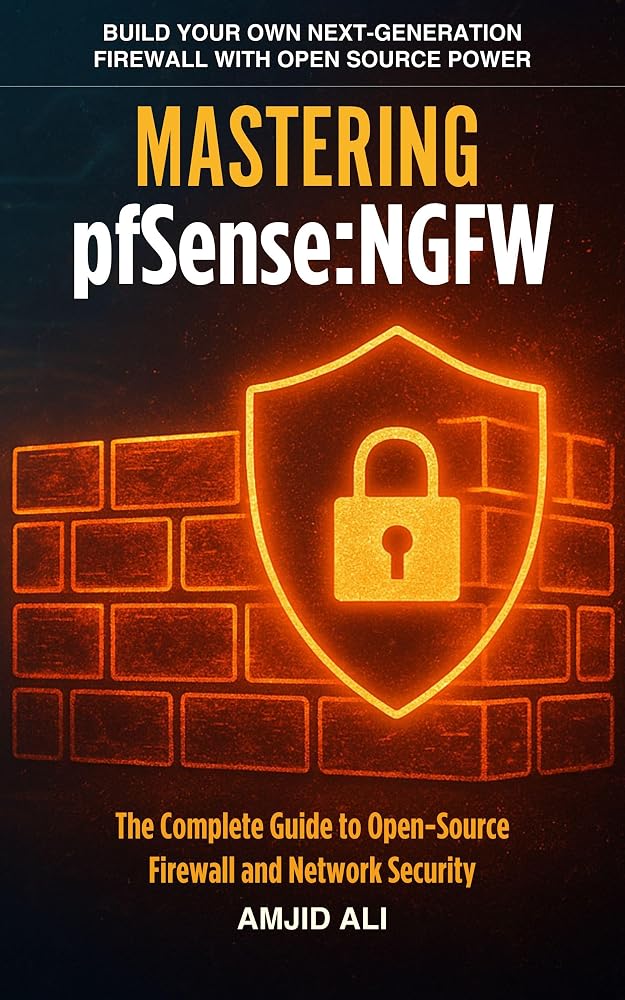
Mastering pfSense NGFW reviewpfSense from first install to VPNs, VLANs, IDS/IPS, pfBlockerNG and high availability
Very good
Brent score, out of 5
Mastering pfSense NGFW is a hands-on, scenario-driven guide that takes you through every major pfSense area, from installation and firewall rules to VPNs, VLANs, Suricata IDS/IPS, pfBlockerNG and CARP failover. It packs a lot of ground into about 140 pages, so each topic is a practical walk-through rather than an exhaustive reference. It suits homelab builders and small-office admins who want a working, secure gateway quickly.
Formats
Kindle, Paperback, Hardcover
Author
Amjid Ali
Best for
Homelab builders replacing a consumer router with pfSense
Opens Amazon in a new tab · We may earn a commission
Disclosure: we may earn a commission if you buy through our links, at no extra cost to you. It never affects our ratings. How we make money
Best for
- Homelab builders replacing a consumer router with pfSense
- Small-office and MSP admins deploying pfSense or Netgate appliances
- Students preparing for firewall and networking certifications
- Proxmox users running pfSense as a virtual firewall
Skip it if
- Network engineers who need an exhaustive reference to every pfSense option
- Readers who need OPNsense-specific instructions
Your network has outgrown the ISP router. You want VLANs for IoT devices, a VPN back home, ad and threat blocking, and maybe a second internet line for failover, but pfSense's menus and package list can feel endless the first time you log in.
Mastering pfSense NGFW is built for that moment. It goes from pfSense architecture and installation through firewall rules, NAT and VPNs to the security packages most people actually want, such as pfBlockerNG and Suricata, and then to high availability, traffic shaping and monitoring.
Disclosure: the author, Amjid Ali, is the founder of this site, so read this as an editorial overview of the book's scope and audience rather than an independent rating.
What is Mastering pfSense NGFW?
Mastering pfSense NGFW is a technical guide by Amjid Ali, published in March 2025 (Kindle print length 142 pages). It is written as both a reference and an implementation guide drawn from real projects and instructional labs. Chapters cover pfSense fundamentals and deployment options, installation on hardware and hypervisors, firewall and NAT rules, OpenVPN and IPsec, network services and VLAN segmentation, security packages (pfBlockerNG, Suricata, Squid/SquidGuard), high availability with multi-WAN and CARP, traffic shaping, monitoring and backup, and a set of practical scenarios.
Pros and cons
What we like
- Covers the full stack: install, rules and aliases, NAT, VPN, DNS/DHCP, VLANs, QoS, HA and monitoring
- Security packages explained: pfBlockerNG for IP reputation and geo-blocking, Suricata for IDS/IPS, Squid and SquidGuard
- Installs on physical hardware and on VirtualBox, Proxmox and VMware
- Real scenarios: guest Wi-Fi with captive portal, IoT isolation, multi-WAN load balancing, branch VPNs
- Available in Kindle, paperback and hardcover
What could be better
- About 142 pages for a very wide scope, so advanced topics get a practical overview rather than full depth
- Self-published, without a large technical publisher's editing process
- pfSense menus and packages change between releases, so some steps may need checking against Netgate's docs
- Very few Amazon ratings so far, so there is little reader feedback to go on
Overall
Very good
- Content4.3
- Clarity4.2
- Practicality4.4
- Value4.1
What’s inside
What you’ll learn
- pfSense architecture and deployment options on hardware, VMs and cloud
- Installing pfSense on physical appliances, VirtualBox, Proxmox and VMware
- Writing firewall rules with aliases, groups and schedules, plus NAT and port forwarding
- Setting up OpenVPN and IPsec for remote access and site-to-site tunnels
- Segmenting networks with VLANs, DHCP, DNS Resolver and Dynamic DNS
- Using pfBlockerNG, Suricata IDS/IPS and Squid/SquidGuard
- Multi-WAN failover, CARP high availability and traffic shaping
- Monitoring, logging, alerts and configuration backups
Installation on hardware and hypervisors
Covers pfSense architecture and deployment options, then installing on physical appliances and on VirtualBox, Proxmox and VMware, with first-time setup and admin hardening.
Firewall rules and NAT
Builds rules with aliases, groups and schedules, then covers NAT, port forwarding and 1:1 NAT, plus using logs and built-in tools to troubleshoot traffic.
VPNs and remote access
Deploys OpenVPN for remote users and site-to-site tunnels, sets up IPsec, and shows how to route through a commercial VPN provider such as Private Internet Access.
Segmentation and network services
Configures DHCP, DNS Resolver and Dynamic DNS, and uses VLANs and interface groups to separate trusted, guest and IoT networks.
Security packages
Installs pfBlockerNG for IP reputation filtering, geo-blocking and ad-blocking, Suricata for intrusion detection and prevention, and Squid with SquidGuard for web filtering.
High availability, QoS and monitoring
Sets up multi-WAN load balancing and failover, CARP clusters with configuration sync, traffic shaping to prioritize users and apps, and logging, alerts and config backups.
Available as Kindle, paperback and hardcover; prices vary by format and Amazon store, so check the current price on Amazon.
Who gets the most from it
Homelab gateway
A homelab owner runs pfSense as a VM on Proxmox, splits IoT devices onto their own VLAN, and adds pfBlockerNG to block ads and known bad IPs across the house.
Small office with remote staff
An IT consultant deploys a Netgate appliance for a 15-person office, sets up OpenVPN for staff working from home, and adds a captive portal for guest Wi-Fi.
Two ISPs, no downtime
A business with two internet lines configures multi-WAN load balancing and failover, then adds a second pfSense box with CARP so a hardware fault does not take the office offline.
How to get the most from it
- 1
Choose a format on Amazon; Kindle is handy beside the pfSense web interface.
- 2
Install pfSense in a VM or on spare hardware using the installation chapter.
- 3
Build your basic rules, NAT and DNS before adding packages.
- 4
Add VLANs, then pfBlockerNG and Suricata, testing each change before the next.
Mastering pfSense NGFW alternatives
| Product | Choose it when |
|---|---|
| Mastering pfSense NGFW 4.2 | Homelab builders replacing a consumer router with pfSense |
| Netgate pfSense documentation | Choose it for free, version-specific reference pages straight from the vendor. |
| pfSense: The Definitive Guide (Buechler and Pingle) | Choose it if you want the long-standing reference written by pfSense developers, keeping in mind its editions are older. |
| Mastering Proxmox4.1 | Choose it alongside this book if you plan to run pfSense as a virtual machine on Proxmox. |
Mastering pfSense NGFW: frequently asked questions
Is Mastering pfSense NGFW good for beginners?+
Yes. It starts with what pfSense is and how to install it, then builds up. Basic networking knowledge (IP addresses, subnets, ports) will make the firewall and VLAN chapters easier.
Does the book cover pfBlockerNG and Suricata?+
Yes. It covers pfBlockerNG for IP reputation filtering, geo-blocking and ad-blocking, and Suricata for intrusion detection and prevention.
Can I run pfSense on Proxmox with this book?+
Yes. The installation chapter covers VirtualBox, Proxmox and VMware as well as physical appliances.
Does it cover OPNsense?+
No, the book is about pfSense and Netgate appliances. Many concepts carry over to OPNsense, but menus and packages differ.
How long is the book?+
Amazon lists a print length of 142 pages for the Kindle edition, published in March 2025. It is also available in paperback and hardcover.
Final verdict
Is Mastering pfSense NGFW worth it?
If you want a secure, segmented network with VPN access and threat blocking, and you would rather follow a clear sequence than piece it together from forums, this book gives you that path. Get your preferred format, spin up pfSense in a VM, and work through it one chapter at a time.
Get it on AmazonAffiliate link · we may earn a commission at no extra cost to you.
Reviewed by
Amjid Ali, Founder and editor
Amjid Ali is a Melbourne-based AI and automation lead, author of five books on infrastructure, automation and digital transformation, and a corporate trainer whose courses on n8n, Proxmox, firewalls and ERP have taught thousands of IT professionals.
Last updated 16 October 2026 · How we review
You might also like
Books
Mastering Proxmox review
A practical path from first Proxmox VE install to clusters, HA and Proxmox Backup Server
Books
Mastering Information Technology review
A plain-English tour of IT, from networks and ERP to cloud, security and AI
Books
n8n Automation Mastery review
Learn n8n from first workflow to AI automations, self-hosting and production deployment